Anthony J. Saab

Beirut

Hi, I’m

Anthony J. Saab

Computer and Communications Engineer. Graduate Fellow at the American University of Beirut.

I build and test systems with an attacker’s model of them in mind.

I’ve taught ethical hacking, written four hundred tests for a codebase that had none, found a bug in a NASA website, and built a currency-exchange platform when the official rate stopped meaning anything. Somewhere in there I stopped thinking of building and breaking as two different jobs.

Say hello How I got here

How I got here

Two threads run through everything since 2019: building things, and taking them apart to see how they fail. They have been converging for a while.

Pick a thread to follow it.

  1. 2018

    Enrolled at AUB

    A B.Eng. in Computer and Communications Engineering.

  2. 2019

    Building: Started teaching

    Undergraduate teaching assistant for Python, programming fundamentals and electric circuits: 150-plus students over two years.

  3. 2020

    Everything closed

    Lebanon’s banks froze deposits, then the campus shut for the pandemic. The sessions I was teaching moved to video calls, and my grades went up anyway.

  4. 2021

    Securing: Internet Security, 100/100

    A graduate course, taken as an undergraduate. The term paper benchmarked Windows Server, Ubuntu and CentOS under DDoS attack; it’s on Zenodo.

  5. 2022

    Securing: Cyber threat intelligence at Potech

    Python modules for passive reconnaissance across rogue app stores and social platforms, packaged in Docker for the team’s deep- and dark-web collection.

  6. 2022

    Building: Research assistant in Economics

    The Python and Twitter-API pipeline behind Lebanon’s Economic Policy Uncertainty index, from raw tweets to weekly and monthly series.

  7. 2023

    Building and securing: Graduated with Distinction

    Coding coach for the web and mobile development lab through the spring; then a degree with Distinction, a 100 in Ethical Hacking, and my name in the acknowledgments of the published index report.

  8. 2024

    Building: Instructor of record

    Two sections of the web and mobile development lab, the same lab I had taken as a student two years earlier.

  9. 2024

    Securing: Started the M.Eng.

    Networks and Security, on a graduate fellowship. Started instructing the Ethical Hacking labs the same term.

  10. 2025

    Building and securing: Murex, IT Infrastructure team

    More than 400 tests for internal tooling and a .NET proof of concept for HashiCorp Vault: building and securing in the same codebase. Earned TryHackMe’s SAL1 the same year, and finished six years of teaching in the fall.

  11. 2026

    Building and securing: Coursework done, and a letter from NASA

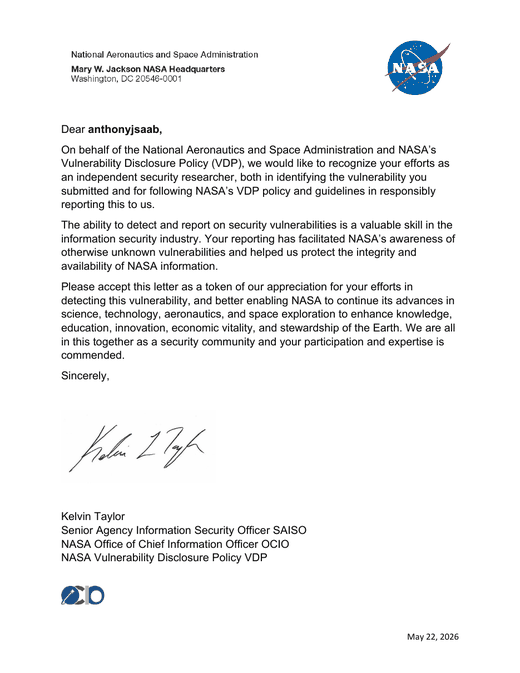
    Finished with an A in DevSecOps and Infrastructure Automation. In May, NASA recognized and publicly disclosed a vulnerability I had reported in January: a stored cross-site scripting flaw on its GLOBE platform. The same month I added CompTIA DataSys+.

Experience

–The codebase had no tests when I arrived.

IT Internal Development Intern, IT Infrastructure team

Murex, Beirut

  • Designed and shipped 400-plus system and unit tests for internal IT tooling, the team’s main testing project, after mapping a codebase that had none.
  • Built a proof-of-concept .NET SDK for HashiCorp Vault, to bring secrets management into the team’s internal tools.
–presentTaught the material I’d scored 100 in.

Graduate Fellow, Department of Electrical and Computer Engineering

American University of Beirut

  • Fellowship held alongside the M.Eng. Lab instructor for Ethical Hacking I and II from 2024 through 2025.
  • Ethical Hacking I: hands-on labs across the kill chain, from reconnaissance and OSINT through enumeration, web and database attacks, password attacks, traffic sniffing and Linux privilege escalation.
  • Ethical Hacking II: Active Directory enumeration and attacks, lateral movement and pivoting, evading antivirus, IDS and firewalls, covert command-and-control, fuzzing, reverse engineering and exploit development.

–The lab I’d taken as a student two years earlier.

Assistant Instructor, Web, Mobile and Application Development Lab

American University of Beirut, Department of Electrical and Computer Engineering

  • Instructor of record for two sections, on a faculty appointment. Taught full-stack delivery, from Flask APIs and React to Android and JavaFX, and the workflow around it: GitHub, OpenAPI, Cloudflare, Heroku.

–Three hours a week, in the lab.

Coding Coach Scholar, Web, Mobile and Application Development Lab

American University of Beirut, Department of Electrical and Computer Engineering

  • Led weekly three-hour lab sessions and coding clinics, and graded assignments, for the lab I would go on to instruct the following year.

–An economics project that needed a programmer.

Research Assistant, Department of Economics

American University of Beirut

  • Built the Python and Twitter-API pipeline behind the Lebanon Economic Policy Uncertainty index: retweet and duplicate handling, bot and plagiarism filtering, keyword sets, weekly and monthly series.
  • Acknowledged by name in the report published by the Issam Fares Institute in August 2023.

–My first job in security.

Cyber Threat Intelligence Intern

Potech Consulting, Beirut

  • Developed Python modules that aggregate passive reconnaissance across rogue mobile-app stores and social platforms, and Dockerized the tooling for the team’s OSINT and dark-web workflows.

–Started in my second year.

Undergraduate Teaching Assistant

American University of Beirut, Department of Electrical and Computer Engineering

  • Python, programming fundamentals and electric circuits: problem-solving sessions, grading and course material for more than 150 students.

Education

– (expected)Coursework done; the thesis is the rest.

M.Eng. in Electrical and Computer Engineering, Networks and Security

American University of Beirut

  • GPA 3.86 on AUB’s graduate scale, where an A+ is 4.3. Coursework complete; thesis in progress under Prof. Ali Chehab, with the defense scheduled for Summer 2027.
  • Computer and Information Security (A+), Cloud Computing (A+), DevSecOps and Infrastructure Automation (A), Introduction to Quantum Computing (A−).

–Done through a currency collapse and a pandemic.

B.Eng. in Computer and Communications Engineering, with Distinction

American University of Beirut

  • Cumulative 85.87/100; Honor List in four terms.
  • 100/100 in Internet Security, Ethical Hacking and Software Engineering II. The first two are graduate courses; I took them as an undergraduate and later carried them into the M.Eng.

Research and recognition

  • May 2026

    NASA Vulnerability Disclosure Program

    A letter of recognition from NASA’s Senior Agency Information Security Officer. The finding: a stored cross-site scripting vulnerability, reachable through an arbitrary file upload, on NASA’s GLOBE platform (globe.gov). Reported on 27 January 2026, accepted at P2 priority and fixed, and publicly disclosed by NASA through Bugcrowd’s CrowdStream on 22 May 2026.

    Read the letter (PDF)   NASA VDP on CrowdStream

  • August 2023

    An Economic Policy Uncertainty Index for Lebanon

    Research report by M. Barakat and S. Altug, Issam Fares Institute for Public Policy and International Affairs, AUB. I’m acknowledged by name for building the Python code behind the index.

    Read the report (PDF)

  • December 2021

    Testing and Comparing the Performances of Windows Server 2022, Ubuntu 20.04 and CentOS 8 under DDoS Attacks

    An empirical comparison of three server operating systems under denial-of-service load, written for Internet Security at AUB with Vincent Nakhle, Ghida Al Hajj Chehade and Hussein Al Moussawi.

    Zenodo, doi:10.5281/zenodo.22723164   ResearchGate

Also listed on my ORCID record.

Projects

  • Galois Field Calculator

    Near-instant arithmetic in finite fields up to GF(2571), the sizes elliptic-curve cryptography runs on. Python and Tkinter. Here is a working corner of it: a multiplier for GF(28), the field AES runs on.

    × = 0xC1

    Modulo x8 + x4 + x3 + x + 1. Type hex (0x57), decimal (87) or binary (0b1010111); the defaults are the textbook example from the AES specification.

  • LBP-FX

    Built during the collapse of the Lebanese pound: a platform that published parallel-market exchange statistics and matched people who wanted to trade.

  • Management System for the Lebanese Scouts

    My final-year project, built for a community I spent eight years in. It collects, validates and stores the organization’s records, with authentication, authorization and fine-grained permissions designed in from the start.

  • anthonyjsaab.com

    This site, and the short links on it. The page is one HTML file; the links run through a small Cloudflare Worker I wrote, one file and one redirect table; and the domain is set up to current standards, with IPv6, DNSSEC, HTTPS and RPKI. It scores 100% on Internet.nl’s website test and is listed in their Hall of Fame.

Credentials

CompTIA certifications

CompTIA stackable certifications

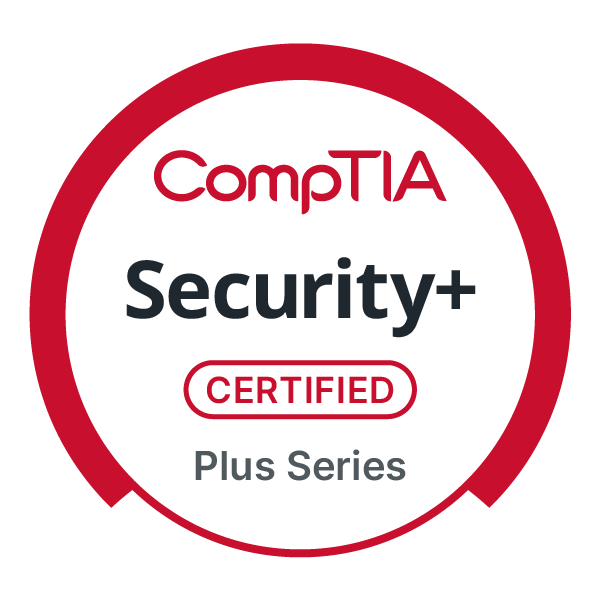
  • CompTIA Security Analytics Professional (CSAP) stackable certification badgeSecurity Analytics ProfessionalCSAP
  • CompTIA Network Vulnerability Assessment Professional (CNVP) stackable certification badgeNetwork Vulnerability Assessment ProfessionalCNVP
  • CompTIA Network Security Professional (CNSP) stackable certification badgeNetwork Security ProfessionalCNSP
  • CompTIA Security Analytics Expert (CSAE) stackable certification badgeSecurity Analytics ExpertCSAE
  • CompTIA Secure Infrastructure Expert (CSIE) stackable certification badgeSecure Infrastructure ExpertCSIE
  • CompTIA Secure Infrastructure Expert (CSIE)

    The top of CompTIA’s stackable path: Security+, CySA+, PenTest+ and SecurityX, which along the way also earn the Security Analytics Professional (CSAP), Network Vulnerability Assessment Professional (CNVP), Network Security Professional (CNSP) and Security Analytics Expert (CSAE) stackables.

  • CompTIA DataSys+

    Databases, end to end: deploying and maintaining them, scripting against them, securing them, and getting them back after a failure. Earned in May 2026.

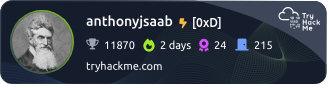
  • TryHackMe Security Analyst Level 1

    Ranked in the top 1% of TryHackMe users worldwide. Profile

  • Microsoft Azure Fundamentals, AZ-900

    Badge

  • Harvard CS50x

    Certificate

  • HackerRank Problem Solving, six stars

    Python. Profile

  • Google IT Support Specialization

    Coursera. Certificate

Skills

Security
Threat intelligence, OSINT, vulnerability assessment, Active Directory attacks and privilege escalation; Burp Suite, Nmap, Wireshark, Kali Linux.
Infrastructure
Linux, Windows Server, Docker, HashiCorp Vault, Cloudflare, Heroku, Azure; databases, from deployment to backup and recovery; networking from the OSI model to routing and switching.
Programming
Python first; Java, C and C++, C# and .NET, SQL, Bash, PowerShell, JavaScript.
Building and testing
Flask, React, REST and OpenAPI, Git and GitHub; system and unit testing against codebases I didn’t write.
Languages
Arabic, French and English, all fluent.

Beyond the work

I spent eight years in the Scouts, as a patrol leader and then a rover, and that community is why my final-year project was built for the Lebanese Scouts. I keep my hands in with competitive-programming problems on LeetCode and Codeforces, and I follow technology and economic news closely, which is partly how a computer engineer ended up writing the code behind an economic-policy index.

Say hello.

If you’re hiring, working on something in security or infrastructure, or just want to compare notes on a problem, I’d like to hear from you.

Email

Ask me about

  • testing a codebase that has no tests
  • storing secrets with HashiCorp Vault from .NET
  • teaching Active Directory attacks to undergraduates
  • what three server operating systems do under a DDoS attack
  • arithmetic in GF(2571)
  • building a currency-exchange app during a currency collapse
  • responsible disclosure, and what a thank-you letter from NASA looks like

Anthony J. Saab, Beirut. Last updated .

This site is one page of HTML, with no analytics and no cookies. Identity proofs are on Keyoxide.

100% score in the Internet.nl website test